
Symposium Brief
This is the brief prepared before the symposium, preserved here in its original event-day voice.
For five years, my question was simple: What can this clinical trial do for me?
For the first time, I was being asked a different question: What can this trial — and future trials — learn from me?
What the trial asked of my life
In 2014 I was diagnosed with breast cancer. After surgery, chemotherapy and radiation, I believed I was in remission. Seven years later, over three weeks in June 2021, that certainty disappeared. A biopsy, CT and bone scan showed that the cancer had returned and spread to my bones. It was Stage IV.
I thought I would have chemotherapy again. Instead, I was offered a place in AMEERA-5, an international randomised, double-blind trial. There was a fifty-fifty chance of the experimental or established treatment, and neither my doctor nor I knew which I would receive. There was no promise that it would help me. I hesitated, because it was after all a trial. But I also knew it was a chance I could not dismiss.
I was in Australia without Medicare and on a temporary medical visa. The trial gave me access to treatment I might not otherwise have been able to reach — and when the trial ended, Pfizer continued to supply palbociclib, the medication that kept me stable.
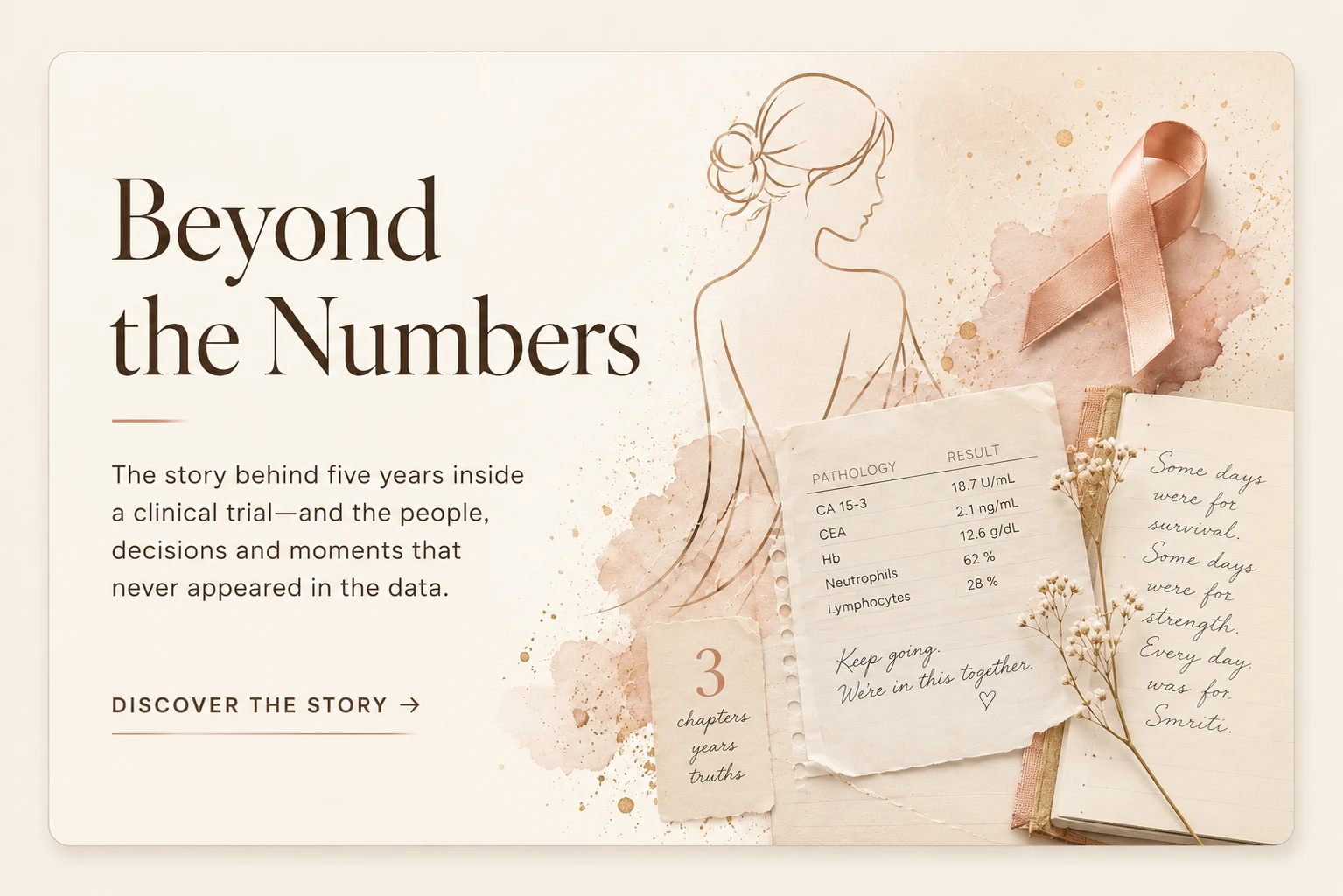
The scans recorded my disease. They did not record Lakshmi, who refused to let me manage alone; Dr Himanshu Kaushik, who looked deeper; Dr Dhanusha Sabanathan and Jenny, who kept care moving; my mother and brother, who supported me from India; or Smriti, who was in Year 9 when I was first diagnosed and grew up carrying the fear of losing her mother.
What I understood only from the inside
Offered with gratitude to the people who cared for me — these are the things I understood only after living inside a trial for five years, and that might help the person who comes next.
Could continuity be designed in, instead of fought for?
When my trial ended, I discovered that treatment doesn't end when a protocol does. Mine continued because Dr Dhanusha, Jenny and the companies involved found a way to preserve it. Could future trials design that continuity from the beginning, instead of relying on exceptional individuals?
Could the space between scans be treated as part of the trial experience?
The waiting and not knowing carry their own weight. The fear does not begin and end on scan day. Between scans, every new pain could become a question. Knowing whom to call, when results would come and what should genuinely worry me would have made the waiting less frightening.
Could the family carrying the journey be recognised?
I signed the trial form, but my daughter lived the trial alongside me. She learnt to drive because there were days I could not, took work calls from waiting rooms and waited for results while trying to build her own career. The trial gave me a fifty-dollar voucher — parking and perhaps a coffee. There was never a questionnaire asking how she was doing.
Could research measure more of the life around the disease?
The trial measured my tumour beautifully. It never measured what stability allowed me to keep — my daughter, my independence, my ability to plan tomorrow, my capacity to contribute, or the hope that life could still move forward.
The moments the records never kept
Long before the scan report, I found myself reading my oncologist's face. Relief arrived before words. So, sometimes, did bad news.
My skin became dry on treatment; my nurse suggested a cream. A tube of cream helped me remain comfortable on a treatment I took for five years.
One conversation changed where I had my blood tests. The test was exactly the same, but it was billed at local rather than international rates and was suddenly covered. The blood test did not change. The bill did.
There was one medicine I never started — recommended from the beginning, about five hundred dollars a month, potentially for life, but outside the trial's coverage. Protocols have boundaries. We live in one body.
The end of the trial frightened me more than the beginning. Technically, my treatment could simply have stopped. It did not — because people advocated until the medicine continued. The science already existed. What kept my treatment going was the people who advocated for its continuation.
For five years I was considered well enough to contribute to research, yet not permitted to work. The financial impact mattered. The loss of purpose mattered even more. It made me wonder whether quality of life should include the ability to remain yourself.
Palbociclib is now available in India. But my team of five years is not there, and the only immediate family I have is here with me. Treatment is not only the availability of a tablet. It is the people who know my history, the trust built over years, and the daughter who can be beside me.
To enter the trial, I had to reconstruct seven years of my medical history — reports scattered across hospitals, clinics and countries.
Even later, I saw how dependent we can become on reception and administrative pathways for information about our own bodies. Dr Dhanusha immediately understood why I needed the reports and resolved it almost at the flick of a finger.
What would have helped was a secure personal health portal linked to the trial and hospital record — much like the secure client login already provided by some radiology services — where I could retrieve my own reports without repeatedly going through reception and coordinator pathways. Even a short summary after each consultation, recording my oncologist's observations, what had changed and why a decision was made, would help me understand my own journey. AI could now make that record searchable and turn five years of scattered documents into a coherent timeline.
Questions my journey left me with
Can we design the end of a trial as carefully as we design the beginning?
Could every long-term trial participant have secure, direct access to their own treatment timeline, reports, medications, consultation summaries and the reasons for clinical decisions?
Could AI help turn those records into understanding — a plain-language summary after each visit, a searchable timeline, a record that travels with the person across specialists and borders — as an aid to the clinician's notes, never a replacement?
I was well enough to contribute to research for five years, but not permitted to contribute professionally. If government policy allows an employer to seek permission for a skilled international worker whose contribution is valued, should there also be a pathway that recognises the life and dignity of a long-term trial participant living in Australia on a temporary medical visa?
When a treatment is available in another country but the established care team and the person's only immediate family are not, what does continuity of treatment really mean?
Looking back, I don't remember many of my blood results. I remember people. The people around me refused to let me fall through the cracks.
Somewhere along the way, this journey also restored a faith I thought I had lost.