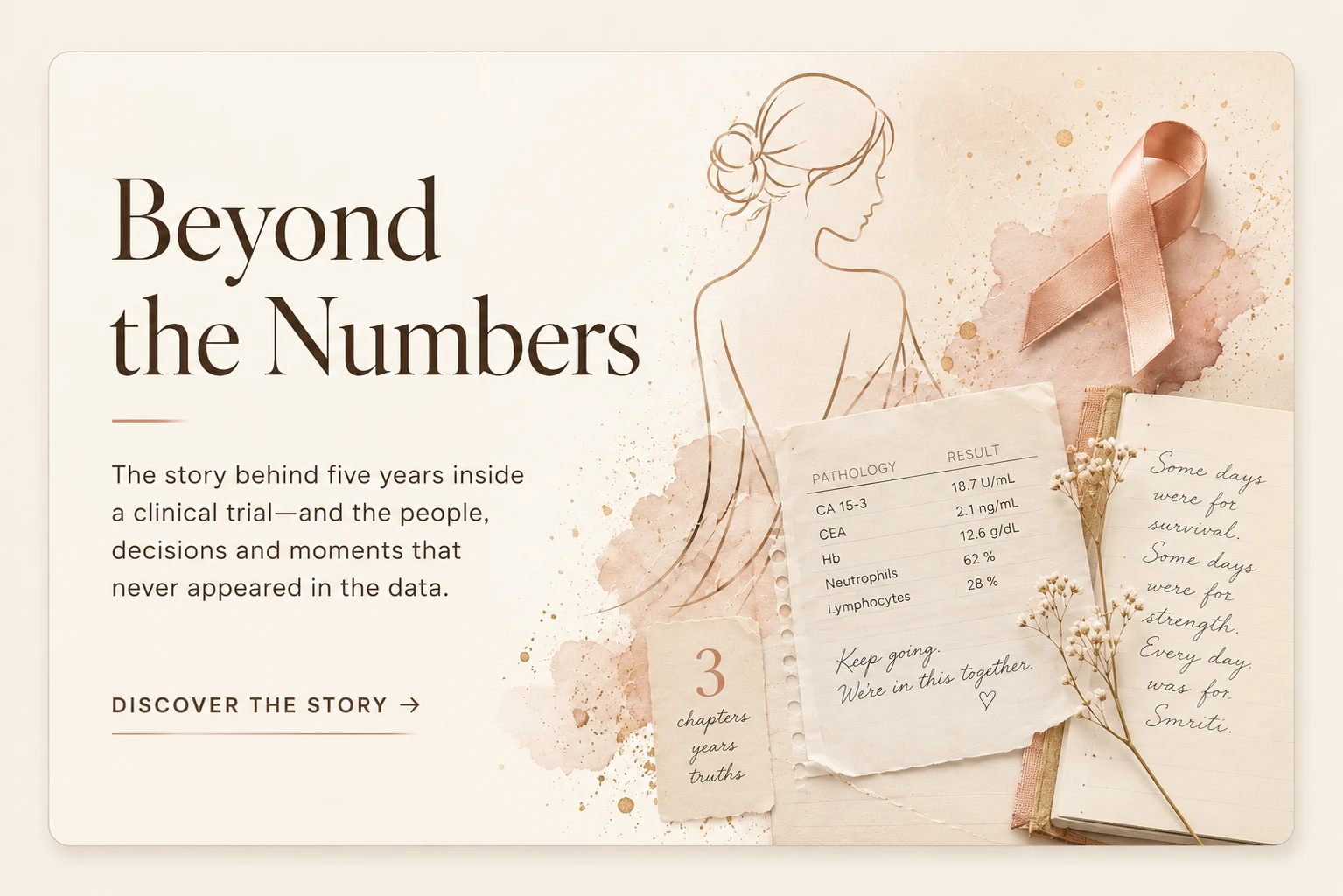

Beyond the Numbers
This is an evolving long-form work. It reaches beyond the symposium and beyond the medical record, gathering the people, decisions, practical realities and unanswered questions that shaped five years inside cancer research.
For a shorter introduction, begin with the four-page Symposium Brief.
Dedication
To my mother, Subhashini, whose quiet faith, unwavering love and daily presence became part of my strength.
To my brother, Pravin, whose words — "Don't let money decide. Choose what gives you the best chance. If we have to pay for it, we'll find a way." — gave me the freedom to make decisions based on hope rather than fear.
To my daughter, Smriti, who gave every stable scan a reason to matter.
And to everyone who quietly became part of this journey.
PROLOGUE — Some Things a Scan Will Never Show
For five years, my question was simple: What can this clinical trial do for me?
For the first time, I was being asked a different question: What can this trial — and future trials — learn from me?
I did not begin writing because I had survived a clinical trial. I began because living inside one for five years changed the way I think about research.
The reports recorded my disease. They never recorded my life.
The trial asked for my blood.
Life asked much more of my daughter.
The trial asked for my scans.
Life asked for my work, my finances, my identity and my faith.
Research was now asking for my perspective.
This is written in my own voice, as plainly as I can manage. It is not a medical record. It is what I understood from the inside of five years in a clinical trial — set down so that it might be of use to the person who comes next, and to the researchers, clinicians and nurses who make trials possible.
The trial measured my tumour, my blood tests and my side effects. It never measured what happened outside the hospital. So this is the story of what five years in a clinical trial asked of my life — and how being invited to contribute back to research became the unexpected opening into another part of that journey.
PART ONE — BEFORE THE TRIAL
Chapter One — What the Trial Never Knew About Me
When I joined the trial, I became a participant number on a protocol. The protocol knew my pathology, my hormone receptors, my bone scans. It did not know who I was.
I am an engineer, an entrepreneur, a designer and a lifelong problem solver. I trained in engineering, and then spent three decades creating things. I designed couture — garments where the label, the swing tag, the packaging, the invoice, even the Diwali card belonged to the same world. Nothing was accidental. I designed homes. I developed property. I built Smritinsha, the project that carries my daughter's name. I raised her, mostly on my own, across two countries.
If there is one thread running through my life, it is this: I have always wanted to leave things a little better than I found them.
I did not stop being a designer when I developed cancer. I simply changed what I was designing. First it was clothes. Then homes. Then buildings. Then a life around my daughter. Then, almost without realising it, a way to live with metastatic cancer.
The canvas changed. The designer didn't.
I tell you this first because researchers meet the diagnosis before they meet the person. In my case, the person arrived with an entire life — habits of noticing, of designing, of holding many moving parts together. Those habits did not disappear at the clinic door. They became part of how I survived.
Chapter Two — I Thought That Chapter Had Ended
In 2014 I was diagnosed with breast cancer for the first time, and treated in India — surgery, then chemotherapy, then radiation. At the end of it I was told I was in remission, and I let myself believe it.
There are small memories from that first treatment that stayed with me longer than the medical facts. I had a beautiful wig, but I lived in my black bandana and my little monkey cap. I cried more when I lost my hair than when I was diagnosed.
One afternoon I walked into a cinema to watch The Fault in Our Stars, with my surgical drain hidden in a bag. My mother said afterwards, "Kya picture ke gayi tum." I cried through the film — because I realised some faults in our stars become Hollywood stories, while others are quietly lived.
For seven years I built a life on the belief that it was over. I raised my daughter. I worked. I made plans the way well people make plans. The fear never entirely left, but it thinned into something I could mostly forget.
I tell you this so you understand what was taken later, and how quickly. It was not only my health. It was seven years of trust I had carefully rebuilt.
Then, over about three weeks in June 2021, one appointment after another quietly took the ground from under me. There was a test, and then a scan, and then another, and each result was a little worse than the last. A biopsy on the first of June. A CT scan on the fifth. A bone scan on the twenty-second. I remember the waiting rooms more clearly than the dates. I remember trying to keep my voice ordinary on the phone so my daughter would not hear the fear in it.
By the end of that month I understood that the cancer had come back, that it had spread to my bones, and that it was now Stage IV.
What I remember most is not the medicine. It is the speed — how quickly a life that had felt safe came apart, and how I had to keep living inside it while it did.
After the diagnosis, Smriti hugged me and said, "We'll get through it." I remember telling her, "I'm only going through this for you."
PART TWO — THE CHAIN BEGINS
Chapter Three — The First Link in the Chain
I do not believe I arrived here alone, or by chance. When I look back, I see a chain of people, and I can name each one.
It began with Lakshmi. She refused to let me face this alone. She would not accept my hesitation, and she insisted on taking me to a radiologist she trusted — her son's father-in-law — at a time when their own family was already living through the pain of cancer. They were carrying their own grief, and they still made room to help me.
That radiologist was Dr Himanshu Kaushik. He looked deeper than he had to, and found what needed to be found. Everyone else had looked. He looked again. That second look changed the trajectory of my life — the diagnosis, the trial, and every one of the five years that followed sit on it.
His wife, Smita, understood the fear and helplessness around cancer because her own sister was seriously ill at the time. She still made room to help me, and I have never forgotten that.
Without Lakshmi, I do not reach the radiologist, or the diagnosis, or the trial. My survival begins with her.
I have never been able to see that chain simply as luck. In my heart, I have always felt there was something larger guiding it.
Chapter Four — The Door That Opened
I expected chemotherapy again. Instead, my oncologist saw something else.
Dr Dhanusha Sabanathan saw possibilities where others might have seen obstacles. She recognised that I might belong in a trial at all — an international clinical trial called AMEERA-5. And she was honest about it, in the way I came to trust: she had her own reservations, precisely because it was a trial. Nobody pretended it was a simple decision.
It was randomised and double-blind. There was a fifty-fifty chance I would receive the new drug and a fifty-fifty chance I would receive the established one, and neither I nor my doctor would know which. The paperwork was honest too: there was no promise it would help me, and it might help others even if it did nothing for me.
I was frightened. I was an international participant. It was an experimental treatment. It was a blind study. There was no guarantee. I hesitated — I had to move past the fear of being a guinea pig.
What finally convinced me was not statistics. It was trust. Jenny. Dr Dhanusha. The feeling that someone would walk beside me.
And there was my family. My brother Pravin, who works in pharmacovigilance and understood exactly what the drugs and the risks meant, said the words that removed the fear from the decision: "Don't let money decide. Choose what gives you the best chance. If we have to pay for it, we'll find a way." Mahesh and Anu remained available whenever I needed another opinion, reassurance or practical help. Mahesh, as a radiologist, helped me look at the medical information again when I needed clarity.
So I said yes. I did not know whether the trial would help me. I knew only that it offered a chance — and a chance was enough.
I thought I was choosing a drug. I know now that I was choosing an entire system — the monitoring, the rhythm, the people who would walk beside me for five years. That understanding took years to arrive.
I signed the consent form on 23 June 2021, my signature beneath my doctor's. I was randomised into the trial on 19 July 2021.
The trial never promised me a cure. The outcome we hoped for was stability. At the time, that sounded like settling for less. Five years later, stability turned out to be one of the greatest gifts I have ever received.
There was one more thing I had to do before the trial would take me — something no one warns you about. I had to reconstruct my own medical history.
I remember running around collecting seven years of reports from different hospitals, pathology labs, surgeons and oncologists — every doctor's advice, every biopsy report, every scan, every treatment, every medication. Seven years is a long time. The records existed, but they were scattered across hospitals, doctors and countries. Even the biopsy had to come from India — Jenny coordinated the pre-trial work, including retrieving it. Finding it all was almost a project in itself.
I wasn't just joining a trial. I was reconstructing my own medical history. And somewhere in that scramble I realised something I never forgot: no one person had my whole story. I did.
PART THREE — LIVING INSIDE RESEARCH
Chapter Five — Kindness Became Part of the Treatment
A trial is not a tablet you take and forget. It is years of blood tests, clinic visits, scans, questionnaires and waiting. And moving through all of it, holding it together, were people.
Jenny, my nurse, was one of the central people in this story, and she carried me through all five years of it. She was the continuity when everything else kept changing: the reassurance around scans and results; the visa support letters I needed to keep being treated; her efforts to reduce the financial barriers where she could. She was simply there when things became overwhelming, in a way that asked for nothing back.
Sometimes the smallest interventions left the biggest impressions. My skin became dry on treatment; Jenny suggested a cream. Five years later, I still remember the cream. She returned phone calls. She arranged reports without making me justify why I needed them. And when the pathology bills arrived at international rates, one conversation with Jenny changed where I had my blood tests — the same test, billed differently, suddenly covered.
The blood test didn't change. The bill did.
I stopped seeing nursing as tasks. I started seeing it as continuity.
Dr Dhanusha treated me — not just my cancer. Long before a scan report was read out, I found myself reading her face. Relief arrived before words. So, sometimes, did bad news. She balanced the discipline of research with compassionate clinical judgement, and gave me confidence in the times I had none.
One day, when I expected another conversation about my cancer, she said something that completely changed my thinking: "I'm not worried about your cancer. Your diabetes is going to kill you." And she sent me to an endocrinologist. She reduced my appointments when she could, to reduce my costs. She treated the whole person, not the loudest disease.
I later had a comparison I never wanted. I was prescribed Ozempic for my diabetes, outside any trial. I desperately wanted it to work. The nausea came, the smell of food turned, and I stopped — and nobody noticed. There was no monitoring, no accountability, no one repeatedly asking how I was coping. I slipped out of a treatment I knew could help me. After five years inside a trial's rhythm of care, that told me something: how much of staying on treatment is the medicine, and how much is the support built around it?
The science kept my disease stable. The people took away enough of the fear for me to keep living inside it.
Chapter Six — The Other Half of the Journey
My story is only one half of what happened. The other half belongs to my daughter, Smriti.
She was in Year 9 when I was first diagnosed — old enough to understand exactly what was at risk. By 2021 she was an international graduate trying to build her career while wondering whether her mother had metastatic cancer.
She learnt to drive because there were days I could not. She sat in waiting rooms and took work calls from them. She took leave even when she had none left. She checked whether I ate properly, exercised, took my medication, managed my diabetes and my blood pressure, and stayed mentally well. She advocated for me when I could not advocate for myself. She carried a share of the fear that no child should have to carry, and she grew up faster than she should have.
The people around us noticed what the paperwork never did. Dr Dhanusha would ask where Smriti was when she wasn't there. Jenny noticed that she came to almost every appointment.
The trial, for its part, gave me a fifty-dollar voucher. It covered parking and perhaps a coffee. There was never a questionnaire asking how my daughter was doing.
Her story is hers to tell, and I will not tell it for her. But mine cannot be told honestly without her.
It left me with a question I have never stopped asking: who else is carrying the trial?
And behind all of it, from India, were my mother, Subhashini, and my brother, Pravin.
My mother and my brother were the two people in the world I knew I could always depend on.
My mother was never part of the medical team. She didn't read scan reports. She didn't discuss clinical trials or treatment protocols. She simply called. Every day. Somewhere along the way, those calls stopped feeling like a routine and became part of the rhythm of my life. Sometimes we spoke about important things. Often we didn't. It might be a simple "How are you today?" or "Have you eaten?" Looking back now, I realise those ordinary conversations carried me through extraordinary days.
Partway through the trial, it was my turn to sit on the other side. I spent three months in India while my mother was in a coma. I had spent years being checked on; now I was the one keeping watch. Smriti said to me later, "Mom, you had your mother for 58 years..." She was right, and it did not make the missing smaller.
Since losing her, I have realised how much I miss that rhythm. It wasn't only the conversations. It was the quiet certainty that, whatever the day had brought, she would call. That certainty became part of my strength. I didn't fully understand it until it was gone.
I don't think grief is only about missing a person. Sometimes it is about missing the ordinary rituals that quietly held your life together. Those daily conversations were one of mine.
When I returned to Australia, Jenny hugged me. We did not discuss blood counts. Just a hug. It meant as much to me as any treatment.
Chapter Seven — Living Between Scans
There were the blood tests, the clinic visits, the scans. My life came to run on their cycles. In the early months it was intensive — fortnightly blood tests, scans every twelve weeks, bone scans every twenty-four. It was never simply "taking a tablet."
But the hardest part was never the machines. It was the waiting between the scan and the result — the ordinary days I spent cooking, working, answering messages, while a quieter part of me simply waited to be told whether I could keep my life a while longer. The fear did not arrive on scan day; it gathered in the week before and sat with me in the week after. At times, in that waiting, I even questioned the diagnosis itself. I had to prepare, each time, for either progression or relief.
And I was not the only one waiting. My daughter learned the rhythm of it too, and I could see her bracing, quietly, each time a scan came due.
For years I did not even know which arm of the trial I was in. I simply continued taking the tablets, going for the scans, and hoping the next report would still say stable. It is a plain word. In those years it was the most beautiful word I knew.
Some days the treatment wasn't the hardest part. Some days I wasn't thinking about the medicine at all. I was thinking about how many rooms I still had to get through — blood tests in one building, scans in another, the pharmacy, reception, scheduling. Everyone busy. Nobody intentionally unkind. I sometimes felt I was moving through a process rather than one joined-up experience. I had spent a lifetime designing experiences — garments, homes, buildings — where every touchpoint belonged to the same world. Now I was living inside one that nobody had designed end to end.
Dedicated psychological support for that space between scans was difficult to obtain. My clinical team cared, but they were already overloaded. The people caring for me always seemed to need the one thing they never had enough of — time.
Five years of stable scans gave me back something I had not dared to plan for: ordinary Tuesdays. Groceries, driving, decisions, documents. A life that kept its shape. Because stability was never only "the cancer did not grow." It meant Smriti could plan. It meant I could think beyond next month. It meant my life restarted.
Which left me with the question this story keeps returning to: what are we really measuring?
Chapter Eight — What Access Really Meant
There is a part of this story the trial records would never show, because it was not medical. It was about whether the treatment could reach me at all.
The trial was not available in India. I was in Australia, where I had come as a visitor with private insurance. Before the trial, I depended on that insurance and had to navigate what was covered, what was billed at international rates and what remained outside cover. It was because of the trial that I went onto a temporary medical treatment visa — without Medicare, and without the right to work. A diagnosis like mine is not only a medical emergency; it is a financial and administrative one. Again and again I had to prove my situation on paper — the visa letters, the documents, the case for being allowed to keep being treated. Jenny wrote those letters. Dhanusha understood, without my having to explain, why my own reports mattered to me.
During the trial, the sponsor covered the trial medicines, consultations, scans and pathology. When the trial ended, that ecosystem fragmented: Bupa took over the scans, consultations and pathology; Pfizer continued the palbociclib — but only after people fought for it; other costs I managed. And one medicine I never started at all: denosumab, recommended from the beginning for my bones, at roughly five hundred dollars a month, potentially for life, sitting outside every safety net. Protocols have boundaries. People don't. We live in one body.
The end of the trial frightened me more than the beginning. I was later told I had been on the experimental arm — amcenestrant — and that the drug was not going to be released. I found myself wondering whether it had helped me or harmed me. But the medicine I was most afraid of losing was not the experimental drug. It was palbociclib, the expensive companion treatment that had been part of keeping me stable.
Technically, my treatment could simply have stopped. Instead, when continued palbociclib was not automatic, Dr Dhanusha and Jenny explored every available avenue, including support from pharmaceutical companies. Pfizer ultimately agreed to continue supplying it. Without that, I would probably have stopped a treatment that was working.
Continuity, I learned, is not one decision. It is many small ones, made by people who chose not to let me fall through the gap.
The science already existed. What changed my outcome was that people refused to let me fall through the cracks. Which leaves the question I would rather ask than any recommendation I could make: can we design systems where extraordinary care does not require extraordinary people?
And there was the work. I had spent three decades creating businesses, designing homes and building projects. For five years I was well enough to contribute to research, yet not permitted to work. I could contribute to research, but I was not permitted to contribute professionally. The financial impact of not working was real, but the loss of purpose and identity was greater. Nobody has unlimited money; staying idle becomes as much an issue as not having family support. Health, I learned, isn't only measured by whether you're alive. It's also measured by whether you're allowed to continue being yourself.
Today, palbociclib later became available in India. But my team, and the only family I have here, are not in India. Treatment isn't just a tablet. Treatment is the team that has known me for five years. It is trust. It is continuity. It is my daughter. Medicine can be shipped. Relationships cannot. Treatment doesn't only travel in a box.
PART FOUR — BEYOND THE NUMBERS
Chapter Nine — Owning My Story
Seven Years in Fragments
To enter the trial, I had to reconstruct seven years of my own medical history — biopsy reports, pathology, scans, treatments, medications — scattered across hospitals, labs and two countries. Somewhere in that scramble I understood something I have never forgotten: no single person had my whole story. I did.
The Tracker
I am an engineer, entrepreneur, designer and lifelong problem solver, so I did what I have always done with a problem I never want to face twice: I designed my way out of it. I built my own longitudinal health record. AI didn't inspire the tracker. The chaos did. Not just scans and blood tests, but treatments, side effects, functional changes, questions, decisions and outcomes — all in one place, in a form both my doctors and I could understand.
The hospital's records knew what happened. Mine also knew what it meant — when I couldn't climb stairs, when I couldn't carry groceries, when I was terrified before a scan. Data tells us what happened. Stories tell us what it meant.
The Portal I Wish Existed
My care was never confined to one country. I sought opinions across borders, and that meant I needed my own records. Sometimes obtaining them wasn't straightforward — I remember trying to convince administrative staff why I needed copies of my own reports. Dr Dhanusha understood immediately and sorted it in a flick of a finger. To her, it wasn't paperwork. It was continuity.
But it shouldn't need her. Some radiology services already give their clients a secure login. What I wished for was the same for my whole story — a secure personal health portal where I could reach my own treatment timeline, reports and medications without going through reception and coordinator pathways. And after every consultation, a short summary of my oncologist's observations — why a decision changed, what changed since the last visit, what she was watching. Not to replace her notes. To help me understand my own journey.
AI could make all of it searchable — five years of scattered documents becoming one coherent timeline. But AI is simply today's tool. Twenty years from now it will be another tool. Ownership remains.
Why I Shared My Data
There is one more thing I did. I chose to share my trial data — not because I had settled some argument about privacy with myself, but because it felt wrong to keep something so valuable to myself. It felt too important to keep.
And underneath it all, the third question this journey keeps asking: what would have made this easier for the person who comes next?
Things That Never Appeared in My Medical Record
Jenny's hug, when I came back after my mother died.
My mother's phone call, every day. "Have you eaten?"
Smriti learning to drive, because some days I could not.
Reading Dhanusha's face before she spoke.
The cream.
The blood test that didn't change, and the bill that did.
The fear that arrived the week before every scan and stayed the week after.
The waiting rooms, and the work calls my daughter took in them.
Seven years of records, collected by hand to earn my place in a trial.
The fifty-dollar voucher.
The work I was not permitted to do.
The faith that quietly came back.
No analysis. No recommendations. Just the record the records never kept.
Chapter Ten — Five Years Later
In July 2026, almost exactly five years after I signed the consent form, Dr Dhanusha invited me to contribute to Macquarie University's Consumer-Engaged Cancer Research Symposium.
For five years, I had asked what the trial could do for me. For the first time, I was being asked what future research might learn from my experience.
I had contributed blood, scans, questionnaires and time. Now I was being invited to contribute something different: what it felt like to live through it.
At the symposium, I was not there to tell researchers what to do. I could only relate my experience as it was — what helped, what was difficult, what the records captured, and what they missed.
The invitation did not close the story. It opened another part of it.
Questions My Journey Left Me With
I was asked what research might learn from someone who lived it. These are not criticisms of the trial or the people who cared for me. I remain deeply grateful. They are simply the things I understood only after living inside a trial for five years — and which might make the experience better for the person who comes next.
Could continuity and access be considered from the beginning?
What happens when a pathway changes, a trial closes, or access cannot be taken for granted? My continuity existed because people fought for it — Dhanusha, Jenny, a company that agreed to keep supplying a medicine. Could the plan include what happens when a treatment pathway changes or ends, particularly for someone whose access cannot be taken for granted? No one's continuity should depend only on individual goodwill. Could the exit be designed from the beginning, rather than only when the trial ends?
Could the space between scans be treated as part of the trial experience?
The waiting and not knowing carry their own weight. The fear does not begin and end on scan day. Clear information, a person to contact and acknowledgement of the waiting could make that space less lonely.
Could the family carrying the journey be recognised?
One person signs the form, but the diagnosis and trial reshape an entire family. The family member who comes to appointments, remembers information and carries fear is part of the reality of the trial, even though only one person is enrolled. There was never a questionnaire asking how my daughter was doing.
Could research measure more of the life around the disease?
Stability, dignity, time with family and an ordinary life matter deeply. The endpoints measured my disease. They did not measure what stability allowed me to keep: my relationship with my daughter, my independence, my plans and an ordinary life. Instead of asking "How are you?", ask "What stopped you living this week?" That answer is actionable.
The Circle Beyond the Clinic
Healing is never the work of a hospital alone.
Alongside the extraordinary clinicians, nurses, researchers and trial teams who cared for my treatment, there existed another, quieter circle. Family. Friends. Homes that became places of refuge. Meals that appeared without being asked for. Phone calls that became part of the rhythm of survival. Waiting rooms that were never sat through alone. Conversations that restored perspective when fear threatened to take over. People who somehow knew what I needed before I did.
They rarely appear in medical records. Yet they quietly carried the life that medicine was working so hard to preserve.
Research cared for my disease. This wider circle cared for my life. Looking back now, I realise neither journey could have succeeded without the other.
With quiet gratitude to Subhashini Kumar, Shikha and Rajeev; Kiran and her family; Anita Apte; Anamika and her family — and to everyone whose name belongs here and lives in my heart.
Acknowledgements
To Lakshmi, who would not let me manage alone. To Dr Himanshu Kaushik, who looked more closely, and to Smita. To Dr Dhanusha Sabanathan and the research team, and to Jenny, who held the line for five years. To Mahesh and Anu. To Dr Vivek Choudhary, whose care for my eyes and my cataract surgeries helped me hold on to another part of ordinary life and independence. To my mother, Subhashini, and my brother, Pravin, who supported me from India. To everyone whose name the records never kept. And, most of all, to my daughter, Smriti — who carried it beside me, and without whom this story would have neither its author nor its heart.
Collectively
When I look back, I do not see one hero. I see a chain of ordinary people, each doing a little more than they had to.
Lakshmi, who refused to wait. Dr Himanshu Kaushik, who looked more closely, and Smita, who made room for me inside her own family's grief. Dr Dhanusha Sabanathan, who kept opening doors and made my continuity her responsibility. Jenny, who held the line for five years. Mahesh and Anu. My mother and my brother, who held me up from India. The researchers and scientists whose work I lived inside. And Smriti, who carried it beside me.
No single person carried this journey. Together, their decisions, care and persistence changed what was possible for me. Researchers and clinicians spend their careers advancing medicine in the laboratory and the clinic. My story is a reminder that outcomes are also shaped by ordinary human decisions — to look a little closer, to listen a little longer, to refuse to let someone face it alone.
In my heart, I have always felt there was something larger guiding that chain of people. I cannot prove it. I only know how it felt.
Somewhere along the way, this journey restored a faith I thought I had lost.
Looking back, I do not remember many of my blood results. I remember people.
Individually, each person did a little more. Collectively, they created something remarkably close to a miracle.
I did not write this to be admired. I wrote it so the next person might receive better care.
Collectively, do better.